
How long does it take to learn kitesurfing?

How long it takes to learn kitesurfing depends on what you count as "learned". Most people need several lessons, not one, to go from never having held a kite to riding with confidence. Flying the kite and body dragging come first, standing up on the board comes next, and plenty of people need more than one attempt before it feels reliable. Riding on your own, upwind and without supervision, takes longer again.
No honest school can give you one exact number. IKO's course pages quote average hours of about 2, 4 and 8 for its first three levels, which adds up to about 6 hours for Levels 1 and 2 and about 14 up to Level 3. They are averages, and wind, practice and the way you learn all change the answer, so this guide gives you realistic ranges, the milestones that matter and a way to plan around them.
How long does it take to learn kitesurfing, stage by stage?
"Learning to kitesurf" is really three smaller goals, and each takes a different amount of time. The IKO path, which KiteMood follows, splits them like this. If you want every level in detail, read IKO kitesurfing levels explained.
| Stage | What you can do at the end | Published guide to time |
|---|---|---|
| 1. Flying the kite (IKO Level 1, Discovery) | Fly a de-power kite hooked into the harness, use the quick release and land the kite yourself | IKO quotes an average of about 2 hours; KiteMood's first lesson is 75 minutes of theory and first fly |
| 2. Body drag and first rides (IKO Level 2, Intermediate) | Body drag, water start in both directions, ride a short distance and stop under control | IKO quotes an average of about 4 hours |
| 3. Riding on your own (IKO Independent, lessons 3J to 3N; Level 3 – Advanced at KiteMood) | Control your speed by edging, ride upwind, turn without stopping, rescue yourself, launch alone and land a basic jump | IKO quotes an average of about 8 hours; KiteMood's Level 3 – Advanced lessons are booked by the hour |
Why a published average is only a starting point
IKO says its averages depend on the student's knowledge, the weather during the course and the spot. Some schools publish longer ranges for the same stages: one school's guide gives 6 to 8 hours for Level 2 alone, against IKO's 4.
A simple comparison shows why no figure is a deadline. Add IKO's first two averages and you reach about six hours, yet KiteMood's 6-hour beginner course stops at body dragging, and the school's own wording is that most people need a third lesson to get up and ride with confidence. Both can be true, because an average hides a wide spread.
What each stage involves
Stage 1: learning to fly the kite
This stage starts on the beach, not in the water. At KiteMood you begin with about an hour on a small trainer kite, then move to a small 4-line kite, learning to set it up, use the safety systems and fly with control. You move on when you can show full control of the kite, the de-power system, one-handed flying and the safety systems, not when a clock runs out, which is why this stage varies. For the details, read what to expect from your first kitesurfing lesson.
Stage 2: body drag and your first rides
Now the kite goes into the water. Body dragging means using the pull of the kite to move through the water without a board. You learn to enter and exit the water while flying the kite, to body drag, to relaunch the kite if it falls and, finally, to body drag upwind with one hand so you can move around independently.
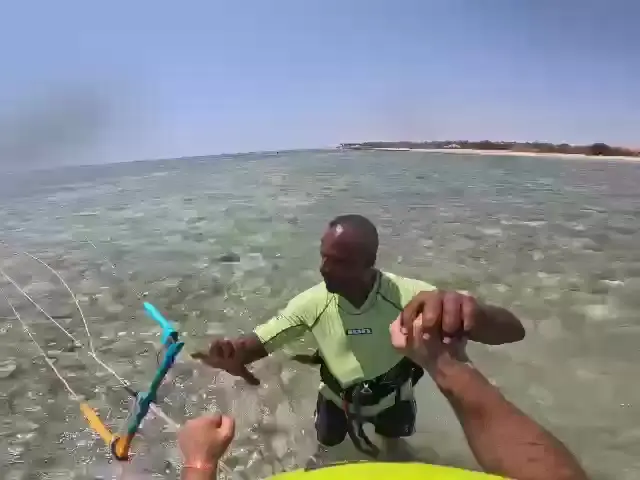
Only then does the board appear. In the waterstart lesson you put the board on and take your first rides, and the body dragging you have just learnt is your safety net: if you fall off, you drag back to your board and restart. KiteMood's own wording is that some people need more time to get up on the board, which is why this is the part of the journey that is hardest to predict.
To complete Level 2 you water start in both directions, ride a short distance and come to a controlled stop. You also learn to read the forecast, to understand the effects of tide and wind and to apply the right-of-way rules.
Stage 3: riding on your own
After the first rides, the work changes from getting up to riding well: controlling your speed by edging, riding upwind, changing direction without stopping, rescuing yourself and launching the kite alone. IKO's own average for this stage is about 8 hours, twice that of Level 2, so plan it as a second step rather than something to squeeze into the same week.
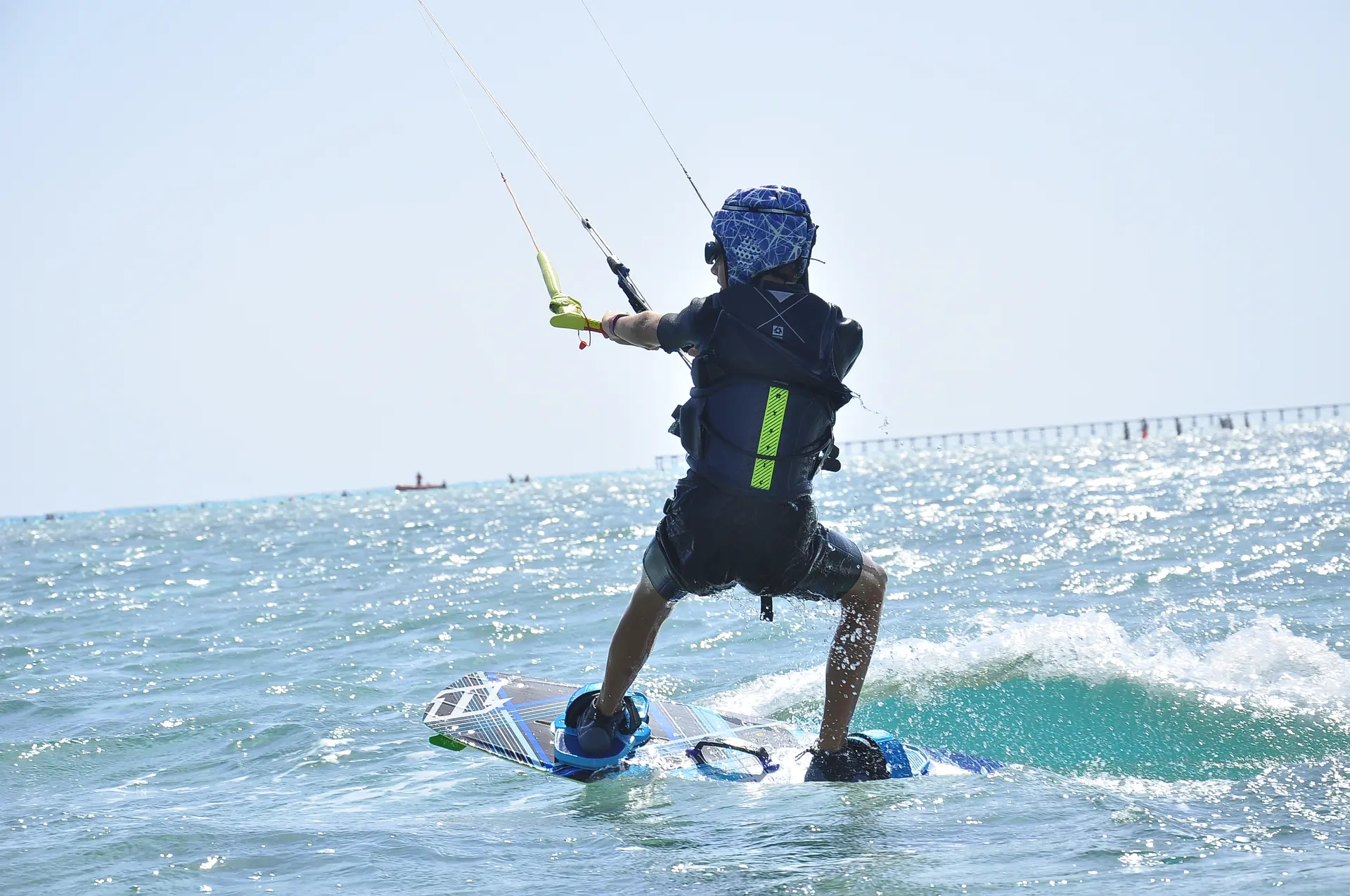
Riding upwind is the milestone to watch. At KiteMood, supervised rental needs IKO Level 2 including 2I, while renting without supervision means being an independent rider who can ride upwind. If you cannot yet stay upwind, supervised sessions are made for you.
For a short holiday, a sensible target is Level 2 and your first rides, with upwind riding as the next goal unless you have plenty of time. That is advice, not a rule.
How the 6-hour and 8-hour courses fit
The 6-hour course: kite control and body dragging
This course has two lessons: kite control on the beach, then body dragging in the water. The aim is to complete the body drag lesson and get you ready for the board. It suits people who want to try the sport first, or who already know they will add lessons afterwards.
KiteMood says fast learners may get to try the board, but most people need a third lesson to get up and ride with confidence. Read more about the 6-hour beginner course.
The 8-hour course: the board is part of the plan
This course has three lessons: kite control, body dragging and a waterstart lesson with the board. It aims to complete IKO Level 2. KiteMood's own wording is that most people progress this way, although some need more time to get up on the board. If first rides are what you came for, look at the 8-hour beginner course.
When you need a little longer
Needing extra time is normal, and there are simple ways to add it. Level 2 lessons are 75 minutes each, and an extra lesson after the course is 60 minutes; the Level 2 – Intermediate page shows how the lesson-by-lesson route works.
Private lessons allow a slower pace or shorter lessons of 1 or 2 hours. They are also the right choice if you are booking alone, because a place in a group lesson cannot be promised.
What speeds you up and what slows you down
There is no formula, but the same few factors come up again and again.
Wind and water
Beginners usually learn best when the wind is moderate and steady, and a big gap between wind speed and gusts means it will feel less steady on the water. Your instructor checks the real conditions on the beach and chooses the kite size for you, so the day's wind decides how much useful time you get.
KiteMood describes its lagoon as huge, with flat water and a big standing area, which the school says helps when you are just starting out, and a very high chance of wind all year round. Wind still varies by month. In NASA model data for the area (2015 to 2024, on a grid about 50 km wide, so not a measurement at the lagoon), the share of days with at least four daytime hours of 12 to 28 knots is highest in September (68%) and June (67%) and lowest in November (19%). Because the model averages a large area, use it only to compare months. The guide to the best time to kitesurf in Marsa Alam goes through the year, and the live wind forecast shows conditions before you travel.
Rhythm, rest and experience
- Gaps between lessons: KiteMood's tricks page says riders who have not practised for a long time need to get their confidence back, so lessons that follow one another closely usually suit beginners better than long breaks. Ask the team to space yours with that in mind.
- Rest: body dragging and repeated waterstart attempts can be tiring. If you are worn out, say so, and ask about a rest day or a shorter lesson.
- Rushing: moving to the board before kite control is solid can cost time. That is why each step is shown before the next.
- Your own experience: IKO names the student's knowledge as one factor. Experience with board sports or kites may help, but there is no reliable data on how much, so do not plan around it.
Practising between lessons
- Ask your instructor what is worth repeating between lessons and what should wait until you are supervised.
- Once you hold Level 2, supervised rental gives you 3-hour sessions with an IKO Assistant Instructor and boat rescue on standby, which is a structured way to turn first rides into real riding.
- After a long break, confidence fades. The refresher course is a private 4-hour course for riders who are already up and riding and want a refresh before they rent.
Planning your lessons
| If you... | A sensible plan | Where to look |
|---|---|---|
| Want to try the sport first | A first lesson or the 6-hour beginner course | Level 1 – Discovery or the 6-hour course |
| Want your first rides on the board in one booking | The 8-hour beginner course, with time to spare for extra lessons | 8-hour course |
| Are travelling alone or prefer your own pace | Private lessons | Packages |
| Have ridden before but not recently, and plan to rent | A refresher before you rent | Refresher course |
| Hold IKO Level 2 and want time on the water | Supervised rental | Supervised rental |
A few habits make any plan work better:
- Start early and leave slack. Book beginner lessons near the beginning of your trip, so a day with less wind or an extra lesson fits in without eating into your last day.
- Ask about changes. KiteMood's pages do not say how lessons are rescheduled when conditions are not right, so ask before you book.
- Describe your experience honestly. Tell the team what you have done before, and how many days you have, on the contact page.
What nobody can promise you
No instructor can tell you in advance how many hours you will need, or on which day you will first ride, because the wind and your own pace decide. Be wary of any promise that you will ride independently after a single lesson.


