
Kitesurfing for beginners: what happens in your first lesson

Kitesurfing for beginners starts on land, not on the water. At KiteMood the first lesson lasts 75 minutes and is described as theory and first fly: you learn the wind and safety basics, then fly a small trainer kite on the beach. You will not ride a board in it, because body dragging and the board come in the lessons that follow.
That order is deliberate. A kite you can steer, de-power and land makes everything in the water safer, so a first lesson is about control, not speed.
Kitesurfing for beginners: your first lesson, step by step
KiteMood is an IKO-approved school and its lessons follow IKO guidelines, so the first stage is Level 1 – Discovery. If you start with a beginner package instead, your first lesson is a kite-control lesson on the beach with the same pattern: a trainer kite first, then a 4-line kite.
| Step | Why it comes first |
|---|---|
| 1. Theory: safe wind, hazards on a spot, safety systems | You need to know when and where it is safe to fly |
| 2. Trainer kite on the beach | Kite control without the power of a larger kite |
| 3. A 4/5-line de-power kite, hooked into your harness | You learn to control power with the bar, as you will in the water |
| 4. Quick release and landing the kite yourself | It proves you can end a flight safely |
How much of this fits into the first 75 minutes depends on you and the day. IKO's course page quotes an average of about 2 hours for Discovery as a whole, and says the real time depends on the student's knowledge, the weather and the spot, so ask the team which steps your first lesson covers. Your instructor moves you on when you can show the skill, not when the clock runs out.
Step 1: wind, hazards and safety systems
You start with ground rules: which wind directions and conditions are safe, how to recognise the hazards on a spot and how the safety systems work. Your instructor checks the real conditions on the beach and chooses the kite size for you, so you never have to work out a size yourself. Beginners usually learn best when the wind is moderate and steady.
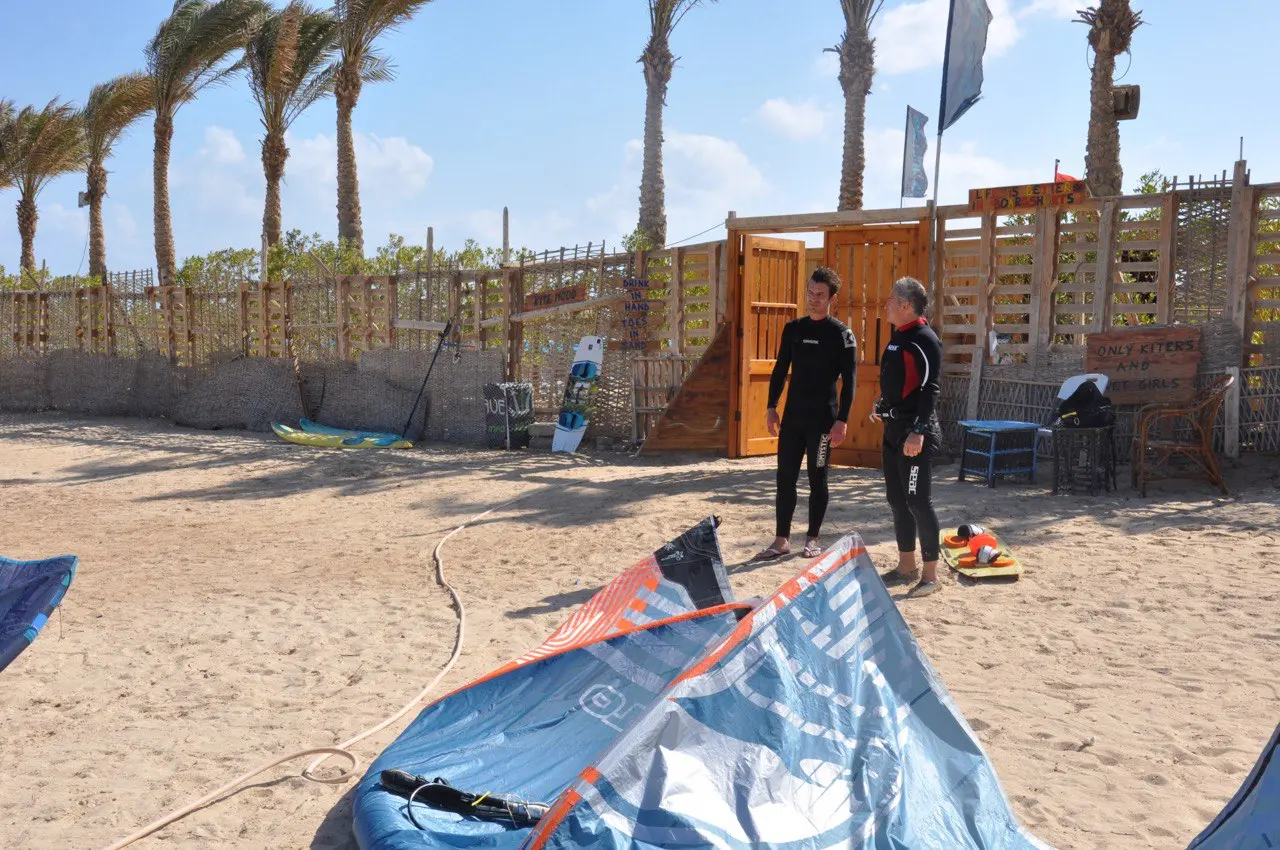
Step 2: the trainer kite
Next comes a small trainer kite, flown on the sand. On the beginner courses this part lasts about an hour and teaches kite control, theory and safety without the power of a larger kite.
You learn to launch and land it with an assistant, to twist and untwist the lines while it flies, and to walk and change direction with the kite in the air. You also meet the wind window, which in plain terms is the part of the sky downwind of you where the kite can fly.
Step 3: a bigger kite, hooked into the harness
Now you move to a 4/5-line kite with a full de-power system, meaning one whose power you can reduce with the bar. On the beginner courses this is a small 4-line inflatable kite (the 6-hour course may use a soft kite instead, depending on the wind). You learn to set it up, run pre-flight and in-flight checks, read the international communication signals, and act as the assistant yourself.
Then you fly it hooked into the harness. Hooked in, the kite's pull passes through the harness rather than only through your arms, so you learn the de-power and safety systems alongside it. On KiteMood's beginner courses you finish the kite-control lesson when you can show full control of the kite, the de-power system, one-handed flying and the safety systems.
Step 4: the quick release and landing the kite yourself
The last skill is the one every later lesson relies on. You pull the quick release and activate the leash, recover the bar and kite, and land the kite by yourself. A quick release is designed to cut the kite's power, but the details differ between bars, so learn yours with your instructor, not from a video. Practising on the beach means the first time you use it is not the first time something goes wrong.
After the first lesson: body dragging and the board
Level 1 ends on the sand. Next the kite goes into the water, and body dragging means using its pull to travel through the water without a board. You fly a bigger kite on longer lines, learn to enter and exit the water with it and to relaunch it if it crashes, and finish with one-handed upwind body dragging so you can move around independently. Your instructor stays right with you.
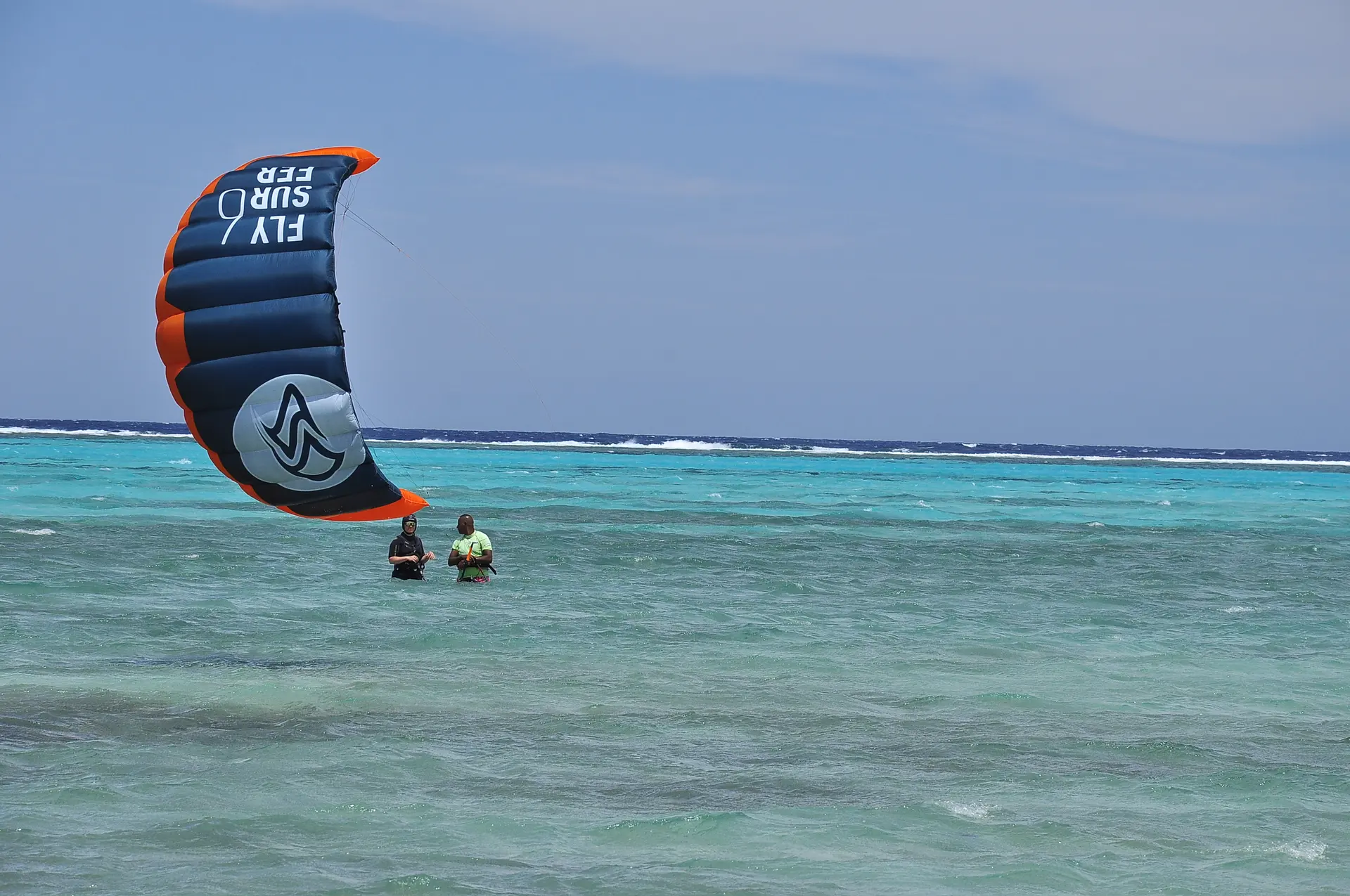
It may sound like a detour before the board, but it is your safety net: if you fall off, you body drag back to your board and restart.
The board arrives in the waterstart lesson. The 8-hour beginner course includes it and aims to complete IKO Level 2, although the school says some people need more time to get up on the board. The 6-hour beginner course stops at body dragging and gets you ready for the board: fast learners may try it, but most people need a third lesson. Your IKO certification (the IKO Kiteboarder Card / vCard) is included once you complete a level. For the full timeline see how long it takes to learn kitesurfing, and for the whole path read IKO kitesurfing levels explained.
What to bring and what to wear
Very little: lessons include kites, boards, harnesses, helmets, life vests, wetsuits and other gear, plus the transfer between the school and the beach. Two things are worth bringing:
- Shoes. The school recommends them for beginners, because dead coral on a strip of rocky sand can be dangerous if you have to cross it.
- Sun protection. NHS advice is at least SPF 30 with at least four-star UVA protection, applied about 30 minutes before you go out and again just before, then every two hours and after swimming or sweating. Water washes sunscreen off, and its cooling effect can make you think you are not burning. Climate averages put Marsa Alam's peak UV index at about 5 in December and 11 or more from April to August, so it matters all year.
Wetsuits are provided. The school's advice for riders is a long wetsuit all year, with a choice of long or shorty in summer. For a list covering the whole trip, see what to pack for a kitesurfing holiday in Marsa Alam.
What to expect on the day
Physically
You will be on your feet, outdoors and concentrating for the whole lesson. The early steps ask for attention and technique before strength, and the effort builds as the kites get bigger and the lessons move into the water. Expect to be tired afterwards, which is a good reason to leave some room between lessons.
KiteMood's pages do not set fitness, weight or swimming requirements. If you are unsure about any of them, or you have an injury or a health condition, ask the team before you book and check with your doctor if needed. Private lessons suit slower learners and allow shorter lessons of 1 or 2 hours.
The conditions
The school describes a huge lagoon with flat water behind a coral reef about 800 metres from the shore, a big standing area and very little change with the tide. It describes the wind as mostly cross to cross-onshore: on a typical windy day it starts from around 10:00, picks up around 14:00 and eases in the evening. When you book, the school confirms your lesson time. The live wind forecast comes from a weather model and can differ slightly from what you feel on the beach.
Common worries
"Can the kite lift or drag me?"
A kite that is too big for the wind, or flown without its safety systems, can pull a person off their feet. That is why the first lesson starts with a trainer kite, why the instructor chooses the kite size, and why you learn the quick release before you go in the water.
Kitesurfing carries real risk, and the answer is to learn with a qualified instructor rather than from videos. At KiteMood lessons are radio-assisted, so you are in touch with your instructor at all times, with no more than two students per instructor and helmets and life vests provided. Kitesurfing safety rules for beginners goes deeper.
"What if I am slow, or the wind is wrong?"
Slower learners are normal, and private lessons suit them. The wind is the instructor's call on the day, and KiteMood's pages do not set out what happens when there is too little or too much, so ask how lessons are rescheduled before you book.
How to prepare and book
- Decide how far you want to go. To try the sport, the first lesson or the 6-hour course fits. For first rides on the board in one plan, look at the 8-hour course.
- Choose a format. On the beginner courses, KiteMood advises private if you are booking alone, because a place in a group lesson cannot be promised. Semi-private suits two people with the same schedule, level and language.
- Start early in your stay. Book your first lesson near the start of the trip, so an extra lesson or a day with less wind still fits in.
- Tell the team the basics. Say when you are travelling, whether you have flown a kite before, your age, how confident you are in the water and anything you are worried about.
Compare every option on the packages page, or message the school through the contact page. After the first lesson, Level 2 – Intermediate continues with body drag and waterstart.


