
IKO kitesurfing levels explained: what each one means

The IKO kitesurfing levels run from 1 to 5: Discovery (1), Intermediate (2), Independent (3), Advanced (4) and Evolution (5). IKO is the International Kiteboarding Organization. Level 1 teaches you to fly a kite safely, Level 2 takes you into the water and up on the board, and Level 3 makes you a rider who can look after yourself, including riding upwind. KiteMood gives lessons for the first three.
The most useful way to read the levels is as lists of skills that an instructor has watched you perform, not as marks out of five. That is what makes them handy: they tell the next instructor, and the next rental desk, what you can already do.
The five IKO kitesurfing levels at a glance
The table follows the names on IKO's own course pages. The letters are IKO's skill codes for the lessons inside each level. Schools can group the lessons slightly differently, so treat the codes as labels and the skills as the real content. IKO also updates its course pages from time to time, so check ikointl.com for the current wording.
| Level | IKO name | Skill codes | What it is about | Taught at KiteMood |
|---|---|---|---|---|
| 1 | Discovery | 1A-1E | Wind, safety systems and flying a kite, ending with the quick release and a self-landing | Yes, as Level 1 – Discovery |
| 2 | Intermediate | 2F-2I | Body drag, recovering your board, waterstart and a short ride | Yes, as Level 2 – Intermediate |
| 3 | Independent | 3J-3N | Riding on your own in every direction, including upwind, plus self-rescue and a basic jump | Yes, as Level 3 – Advanced |
| 4 | Advanced | 4O-4Y | Jumps with a grab, power jibes and jump transitions, plus rider and board recovery | No |
| 5 | Evolution | By discipline | Specialising in freeride, freestyle, hydrofoil or wave riding | No |
One naming wrinkle is worth knowing. KiteMood's course page for the third stage is called Level 3 – Advanced, while IKO's own name for the same 3J-3N stage is Independent, and IKO uses "Advanced" for its Level 4. KiteMood's page itself says these lessons make up the Independent group of the IKO path. The skills are the same whichever label you meet. If a school advertises an "advanced" course, check whether it means 3J-3N or IKO's Level 4.
What each level means in practice
Level 1 – Discovery: learning to control a kite
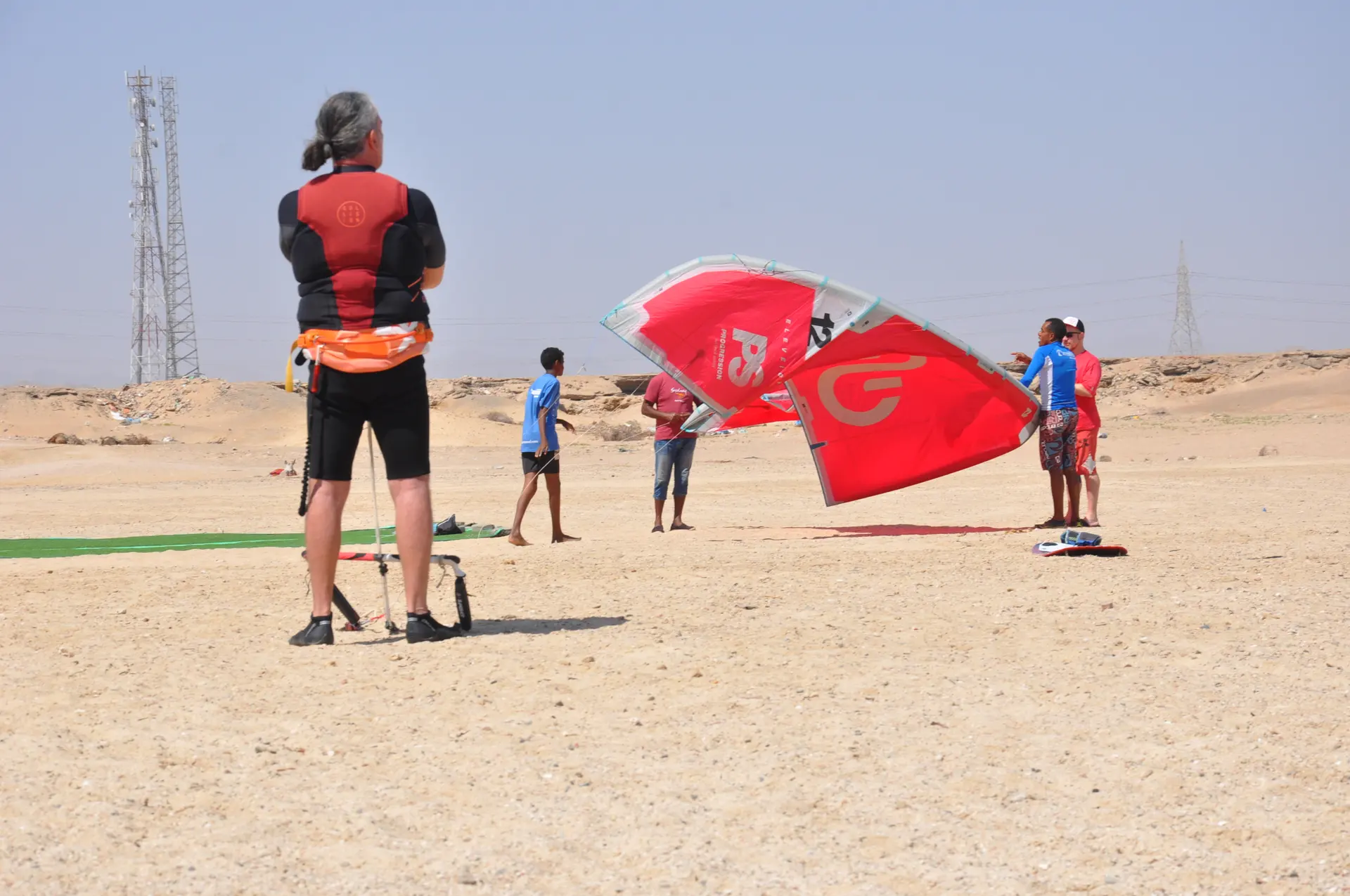
Level 1 is about flying a kite safely, and much of it happens on the beach. You learn which wind and conditions are safe, how to recognise hazards on a spot and how to use the safety systems. You start with a trainer kite, move to a 4/5-line de-power kite (one whose power you can reduce with the bar), fly it hooked into the harness, and finish with the quick release and a self-landing. What happens in your first lesson walks through it step by step.
At KiteMood the first lesson is 75 minutes of theory and first fly, private or in a group. Finishing Level 1 does not mean you can kitesurf yet. It means you have the kite control and safety habits that every water lesson builds on.
Level 2 – Intermediate: the water, then the board
Level 2 takes the kite into the water: entering and leaving it under control, relaunching, body dragging downwind and upwind, recovering your board, then the waterstart in both directions, a short ride and a controlled stop. You also learn to read the forecast and the effects of wind and tide, the right-of-way rules, and how to choose equipment for the conditions.
This is where riding begins, but be realistic about what it certifies. A short ride and a controlled stop is a genuine milestone, yet it is not a full session on your own. KiteMood's 8-hour beginner course aims to complete Level 2, and how long it takes to learn kitesurfing explains why some people need more time to get up on the board.
Level 3 – Independent: riding on your own
Level 3 is about independence. You learn to control your speed by edging and to ride consistently in both directions, including upwind, which is what lets you get back to where you started instead of drifting downwind. You ride among other water users and respect the right-of-way rules, change direction without stopping, and carry out a self-rescue and a full pack-down in the water. You also learn to assess risk and know your riding area, launch the kite by yourself, make a toe side turn and learn the safety rules for jumping before you land a basic jump.
KiteMood teaches this stage as Level 3 – Advanced, in five lesson stages from 3J to 3N.
Levels 4 and 5: beyond the school courses
IKO's Level 4, called Advanced, builds on Independent. Its course page lists a minimum age of 12, about 10 average hours and skills such as a power jibe, a jump with a grab, jump transitions and recovering a rider and a board. Level 5, Evolution, is organised around disciplines: freeride, freestyle, hydrofoil and wave riding, taught by IKO coaches. IKO's handbooks suggest being comfortable with the skills from levels 1 to 4 before you attempt Evolution tricks.
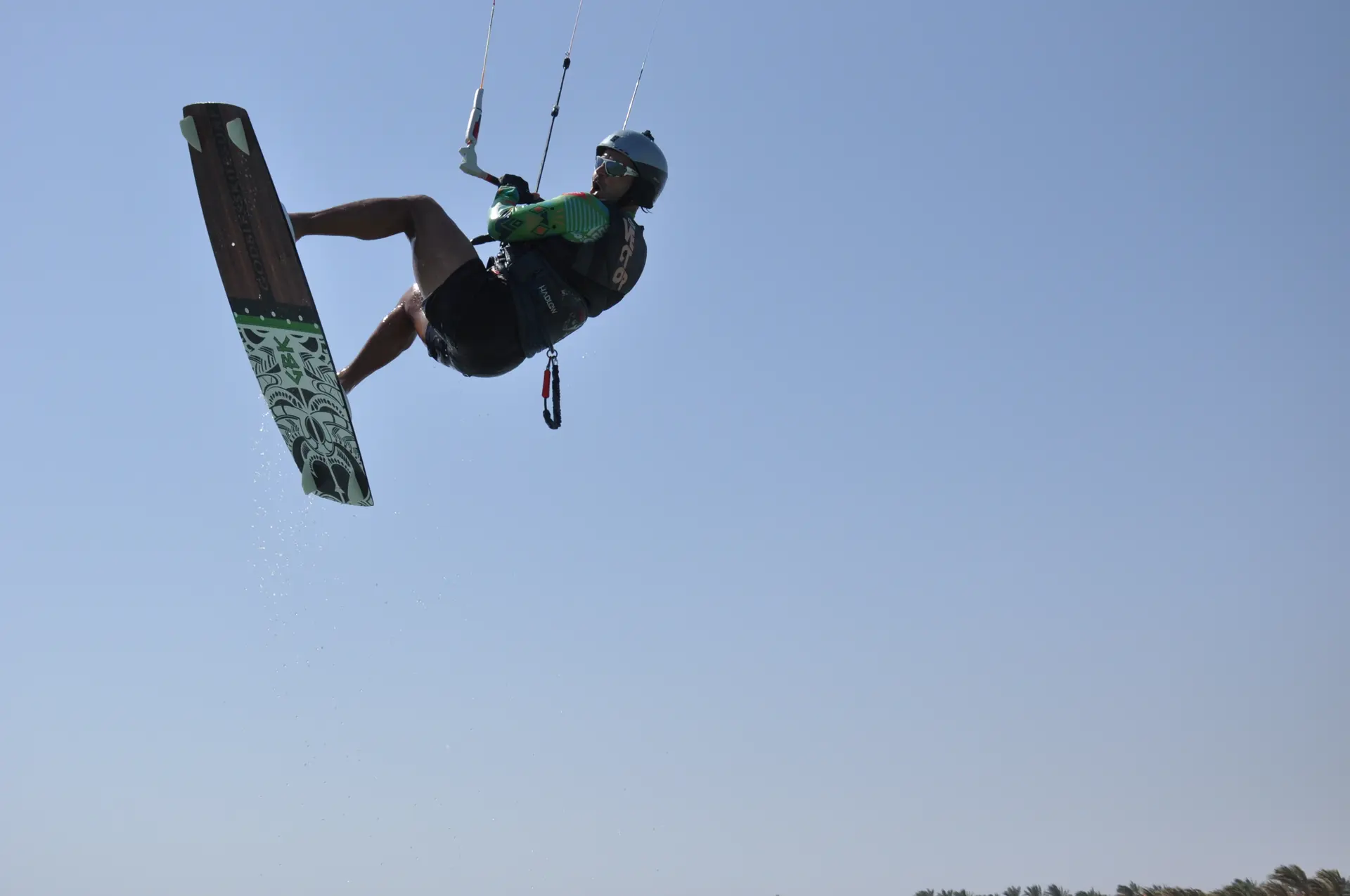
KiteMood does not give lessons for Level 4 or 5. Confident riders can book the separate advanced kitesurfing tricks session: two hours, one-to-one with an IKO instructor, covering jumps, power turns, switch riding and back rolls. It is a coaching session, not one of the three level courses.
How KiteMood's lessons fit the path
KiteMood is an IKO-approved school that has been giving kite lessons since 1998. All its instructors are trained and certified by IKO, and the lessons follow IKO guidelines. Here is where each stage sits:
- Level 1 – Discovery: the first lesson covers theory and first fly.
- Level 2 – Intermediate: the lessons continue with body drag, waterstart and self-rescue, numbered on from the first lesson.
- Level 3 – Advanced: lessons for 3J to 3N are booked by the hour, for riders who can already waterstart and ride.
- Packages: the 6-hour beginner course covers kite control and body dragging, and the 8-hour course adds a waterstart lesson and aims to complete Level 2.
Every lesson is radio-assisted, with a maximum of two students per instructor, and the equipment you use in lessons is included. If you are not sure where you fit, this table helps. You can also compare every stage on the kitesurfing courses page.
| Where you are now | A sensible next step |
|---|---|
| You have never flown a kite | Level 1 – Discovery, or a longer beginner package if you would rather plan the whole journey |
| You can fly a kite and want to get up on a board | Level 2 – Intermediate, or the 8-hour beginner course |
| You can waterstart and ride a short distance | Level 3 – Advanced lessons, to work on speed, upwind riding and turning |
| You have ridden before, but not recently | The refresher course before you rent |
| You hold an IKO certification from another school | Message the team with your level and goal, and say what you have already done |
Why your certification matters
A level certificate is not a trophy. It is a record that a qualified instructor watched you do specific things safely, and it helps in three practical ways.
Renting equipment
Rental centres need to know that you can look after yourself on the water, and your level is the quickest way to show it. At KiteMood the rules are these:
- Unsupervised rental: you need to be an independent rider and be able to ride upwind, which is roughly what the Independent stage teaches. A deposit applies and the rental terms apply, so ask for the details when you enquire.
- Supervised rental: you must have completed IKO Level 2, including 2I. An IKO Assistant Instructor stays with you and boat rescue is on standby.
- No card yet: you get a short assessment before you rent.
See equipment rental and supervised rental for the details.
Moving between schools and spots
IKO says its certification is recognised in more than 60 countries. At KiteMood the certificate is called the IKO Kiteboarder Card and is included once you complete a level. IKO itself now presents its certification as a virtual card, the vCard, in the IKO app, so you may see both names. IKO suggests keeping your app profile complete, because it helps a centre see your level. The new school may still want to see you ride before it hands you equipment.
What the card does not do
It is not a legal licence, and it does not oblige any operator to rent to you. Each school or rental centre sets its own rules. Other organisations, such as VDWS in Germany and the BKSA in the UK, run their own certification systems, so ask any school which cards it accepts before you travel.
A card also records the past. Conditions change from spot to spot and skills fade without practice, which is why a refresher before renting is a sound idea.
Choosing a school and your next step
Before you book lessons anywhere, ask four things:
- Is the school IKO-approved, and are the instructors IKO-certified?
- Which level will I finish, and when is the certificate issued?
- What equipment is included, and is there radio contact with the instructor?
- How many students share one instructor?
At KiteMood the answers are an IKO-approved school with IKO-certified instructors, certification once you complete the level, equipment and radio-assisted lessons included, and no more than two students per instructor.
To go further, look at the safety habits every level builds on in kitesurfing safety rules for beginners.


